Running out of CO2 in the middle of preparing a sparkling drink or maintaining your aquarium can be frustrating and inconvenient. Whether you use a soda maker, a kegerator, or a planted aquarium system, knowing how much carbon dioxide remains in your cylinder is crucial for uninterrupted operation and efficient planning. While a pressure gauge might seem like the obvious indicator, it can often be misleading for CO2 tanks. This guide will reveal the most accurate methods to check your CO2 levels, ensuring you’re never caught off guard.
Understanding Your CO2 Cylinder: Why Knowing Your Levels Matters
CO2 cylinders store carbon dioxide as a liquid under high pressure. This unique storage method is key to why traditional pressure gauges don’t accurately reflect the remaining gas volume. Inside the cylinder, liquid CO2 is in equilibrium with its gaseous form. As gas is drawn from the cylinder, some of the liquid CO2 vaporizes to replace it, maintaining a relatively constant pressure until almost all the liquid has been converted to gas. This means your pressure gauge will show a “full” reading for most of the tank’s life, only dropping significantly when the tank is nearly empty.
Monitoring your CO2 levels is vital for several reasons. For soda maker enthusiasts, it ensures a continuous supply of bubbly beverages. Kegerator owners need consistent CO2 to dispense beer correctly and maintain carbonation. In planted aquariums, a steady CO2 supply is essential for plant growth. By understanding and actively checking your CO2 levels, you can avoid unexpected interruptions and ensure optimal performance from your equipment.
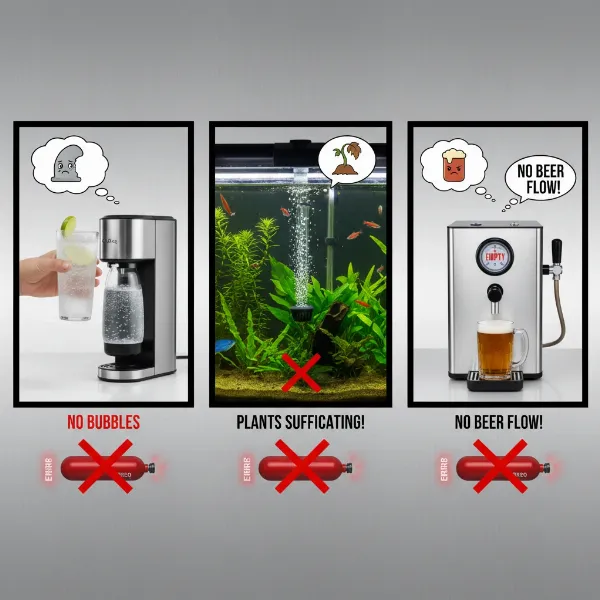 Visual representation of various CO2 systems: a soda maker, a planted aquarium, and a kegerator, emphasizing continuous supply.
The Most Accurate Method: Using Tare Weight and a Scale
The most reliable way to determine how much CO2 is left in your cylinder is by weighing it. This method accounts for the actual mass of the liquid CO2 remaining, providing a precise measurement.
What is Tare Weight (TW)?
|
Our Picks for the Best Soda maker in 2026
As an Amazon Associate I earn from qualifying purchases.
|
||
| Num | Product | Action |
|---|---|---|
| 1 | SodaStream Terra Sparkling Water Maker Bundle in Black - includes 3-Pack CO2 and Carbonating Bottle |

|
| 2 | Soda Siphon 1L,Portable Sparkling Water Maker,Compact Carbonated Water Machine for Flavored Drinks Reusable Beverages Machine Kit,Travel Soda Machine for Home & Outdoor |
|
| 3 | Mysoda Ruby 2 Sparkling Water Maker - Soda Streaming Machine Silent Carbonated Water Machine Robust Long-Lasting Aluminium Soda Maker 1L Water Bottle Without CO2 Cylinder - Black Copper Soda Machine |
|
| 4 | Philips Soda Streaming Machine, Stainless Sparkling Water Maker Easy Install with Quick Twist 1L PET Carbonating Bottle, Soda Maker Compatible with 60L CO2 Carbonator (NOT Included), ADD4902BKOQ/37 |
|
| 5 | Philips Sparkling Water Maker ADD4901BKOQ/37, Plastic Soda Streaming Machine with Quick Twist Bottle, 1L BPA free PET Carbonating Bottle, Soda Maker Compatible with 60L CO2 Carbonator (NOT Included) |
|
| 6 | SodaStream - Terra Soda Streaming Machine - STARTER KIT - Sparkling Water Maker with CO2 & Bubly Drop - Eco-Friendly, No Batteries Needed - Black |
|
| 7 | SodaStream - Terra Sparkling Water Maker - VALUE BUNDLE - CQC CO2 system - Includes 2x CO2 Cylinders, 3x 32 Fl Oz Dishwasher Safe Bottles, 2x Bubly Flavor Drops - Combine with Pepsi Flavors - Black |
|
| 8 | Black Stainless Steel Sparkling Water Maker Soda Machine Includes 1L Stainless Steel Black Bottle and 1 C02 Cylinder |
|
| 9 | Philips Sparkling Water Maker, Soda Streaming Machine with Quick Twist Bottle, 1L BPA free PET Carbonating Bottle, Soda Maker Compatible with 60L CO2 Carbonator (NOT Included), ADD4902BKOQ/37 |
|
| 10 | Ninja Thirsti Drink System, Soda Maker, Create Unique Sparkling and Still Drinks, Personalize Size and Flavor, Carbonated Water Machine, 60L CO2 Cylinder, Variety of Flavors, Color Black (model 1001) |
|
Every CO2 cylinder has a “tare weight” (often abbreviated as “TW” or “T.W.”) stamped directly onto its neck or shoulder. The tare weight represents the empty weight of the cylinder itself, including the valve, but without any CO2 inside. This is a critical piece of information for accurately gauging your remaining gas. The tare weight is typically expressed in pounds (lbs) or kilograms (kg).
Step-by-Step Guide to Weighing Your Cylinder
To use the tare weight method, you’ll need a scale. A standard bathroom scale is often sufficient for home use, though a more precise digital scale can offer greater accuracy.
-
Locate the Tare Weight: Find the “TW” marking on the neck or shoulder of your CO2 cylinder. Note this number down.
-
Disconnect the Cylinder: Safely disconnect your CO2 cylinder from any attached regulators or equipment. Ensure the cylinder valve is closed.
-
Weigh the Cylinder: Place the disconnected cylinder on your scale. Record its current total weight.
-
Calculate Remaining CO2: Subtract the tare weight (TW) from the current total weight. The result is the amount of liquid CO2 remaining in your cylinder.
- Formula:
Current Total Weight - Tare Weight (TW) = Remaining CO2 (in lbs or kg)
Example: If your cylinder’s tare weight (TW) is 7.5 lbs and your scale shows the current total weight is 10 lbs, then you have 2.5 lbs of CO2 remaining (10 lbs – 7.5 lbs = 2.5 lbs).
- Formula:
This method provides a far more accurate assessment than relying solely on a pressure gauge. It’s an excellent habit to weigh your tank periodically, especially if you want to track your usage patterns.
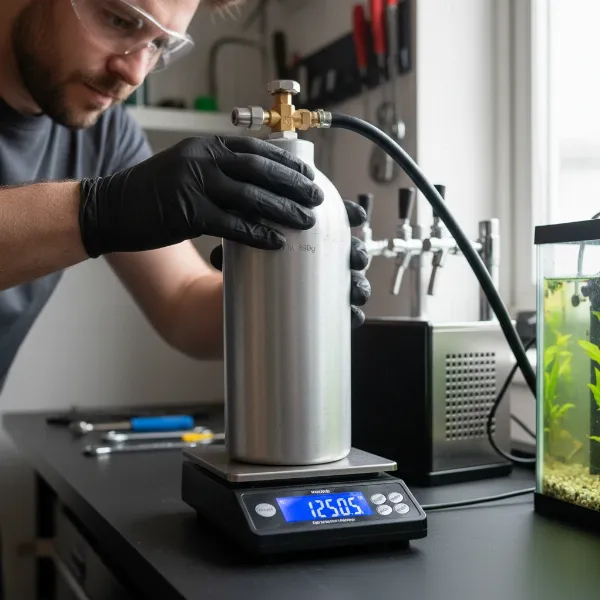 Person weighing a CO2 cylinder on a digital scale to determine remaining carbon dioxide by tare weight.
“For anyone serious about maintaining consistent CO2 supply, weighing your tank against its tare weight is the gold standard. It takes the guesswork out of estimating levels.” – Alex Nguyen, Lead Technician, Sodamakerpro.com
Why Your Pressure Gauge Isn’t a Reliable Indicator
As mentioned, a high-pressure gauge on a CO2 regulator measures the pressure of the gas inside the cylinder, not the volume of liquid CO2. Because CO2 is stored as a liquid and converts to gas as it’s used, the pressure within the cylinder remains relatively constant (around 800-1000 psi at room temperature) until nearly all the liquid CO2 has vaporized.
This phenomenon means your gauge will read “full” or near-full for a significant portion of the tank’s life. Only when the liquid CO2 is almost entirely depleted will the pressure begin to drop rapidly. By the time the gauge shows a significant decrease, you’re likely already very close to running out. Therefore, while a dropping pressure gauge indicates an almost empty tank, it offers little warning or accurate measurement of the remaining CO2 content before that point.
However, the pressure gauge can still be useful for other purposes:
- Leak Detection: A sudden, inexplicable drop in pressure (when not in use) can indicate a leak in your system.
- Empty Tank Confirmation: Once the pressure gauge reads zero, you can be certain the tank is empty.
Alternative and Less Accurate Methods (and When to Use Them)
While weighing is the most accurate, other methods exist, though they offer less precision.
The “Lift Test” (Estimation by Feel)
This is a quick, informal method where you simply lift the cylinder to estimate its weight. With experience, you might develop a rough sense of whether the tank is full, half-full, or nearly empty.
- Pros: Quick, requires no tools.
- Cons: Highly subjective and unreliable for precise measurement. Best used for a very rough “is it completely empty or does it have some gas?” check.
Frost Line Method (for Larger Tanks)
This method is more applicable to larger industrial-sized CO2 tanks, but can sometimes be attempted on smaller ones.
- Carefully pour warm (not hot) water down the side of the cylinder.
- Observe the exterior of the tank. The liquid CO2 inside will absorb heat from the water, causing condensation or a frost line to appear on the outside of the tank at the level of the liquid CO2.
- Pros: Can provide a visual indication of liquid level.
- Cons: Not always precise, can be messy, and the frost line may not be very distinct on smaller cylinders or in certain environmental conditions.
How to Prolong Your CO2 Cylinder’s Lifespan and Monitor Usage
Beyond checking levels, proper care and monitoring can help you get the most out of your CO2 cylinder.
Proper Storage
Store your CO2 cylinder upright in a cool, dry, well-ventilated area, away from direct sunlight or heat sources. Extreme temperatures can affect the pressure and safety of the tank.
Checking for Leaks
Regularly check for leaks in your CO2 system. You can do this by applying a soapy water solution to all connections (regulator, hoses, etc.). If bubbles appear, you have a leak that needs to be addressed. Leaks are a common cause of unexpectedly empty tanks.
Tracking Usage Patterns
Keep a log of when you replace or refill your CO2 cylinders and how long each cylinder lasts. This helps you understand your consumption rate and anticipate when a refill will be needed, allowing you to plan ahead.
Top Considerations When Reordering or Refilling CO2
When your CO2 cylinder is running low, it’s time to think about a refill or exchange.
Finding Reputable Suppliers
Always choose a reputable supplier for CO2 refills or exchanges. This ensures you receive food-grade CO2 (if for beverages) and that your cylinder is filled safely and correctly. Homebrew supply stores, welding supply shops, and specialized gas distributors are common sources.
Understanding Cylinder Sizes
CO2 cylinders come in various sizes (e.g., 5 lb, 10 lb, 20 lb). Knowing your cylinder’s capacity helps you understand how much CO2 it holds when full and allows you to calculate the percentage remaining after weighing.
Safety Precautions
Always handle CO2 cylinders with care. Ensure they are secured to prevent tipping and follow all manufacturer guidelines for connection and disconnection. CO2 is a high-pressure gas, and safety should always be your top priority.
Conclusion
Accurately checking the CO2 level in your cylinder is simpler than you might think, provided you use the right method. While pressure gauges offer limited insight, the tare weight method, involving a simple scale and calculation, provides a precise and reliable way to know exactly how much CO2 remains. By adopting this practice, along with proper maintenance and proactive monitoring, you can ensure a consistent supply for your Soda Maker, kegerator, or aquarium, avoiding unexpected disruptions. What steps will you take to proactively manage your CO2 levels?
Frequently Asked Questions
How often should I check my CO2 cylinder?
For frequent users, checking weekly or bi-weekly is a good habit. For occasional users, a monthly check or before any major event (like a party for a kegerator) should suffice. Consistent monitoring based on your usage helps prevent running out.
Can I use a regular bathroom scale?
Yes, a regular bathroom scale is usually sufficient for residential CO2 cylinders. While not laboratory-grade, it provides enough accuracy to determine the remaining CO2 by weight, especially when compared to the tare weight stamped on the cylinder.
What does the high-pressure gauge on my CO2 regulator mean?
The high-pressure gauge indicates the internal pressure of the CO2 cylinder. For cylinders containing liquid CO2, this gauge will show a constant high reading (e.g., 800-1000 psi) until almost all the liquid has converted to gas. It only drops when the tank is nearly empty, meaning it’s not an accurate indicator of how much CO2 is left, but rather if there is any CO2 left.
How do I know if my CO2 tank is leaking?
A primary indicator of a leak is a drop in the high-pressure gauge reading when the system is not in use, or if your CO2 runs out much faster than expected. To pinpoint a leak, spray a soapy water solution on all connections (regulator, tubing, fittings); bubbles will form where gas is escaping.